OpenAI Unveils Prism: AI-Native Workspace to Revolutionize Science
OpenAI's new Prism platform integrates GPT-5.2 directly into scientific writing workflows, promising to accelerate research collaboration and reduce friction in everyday scientific work.
OpenAI Unveils Prism: AI-Native Workspace to Revolutionize Science
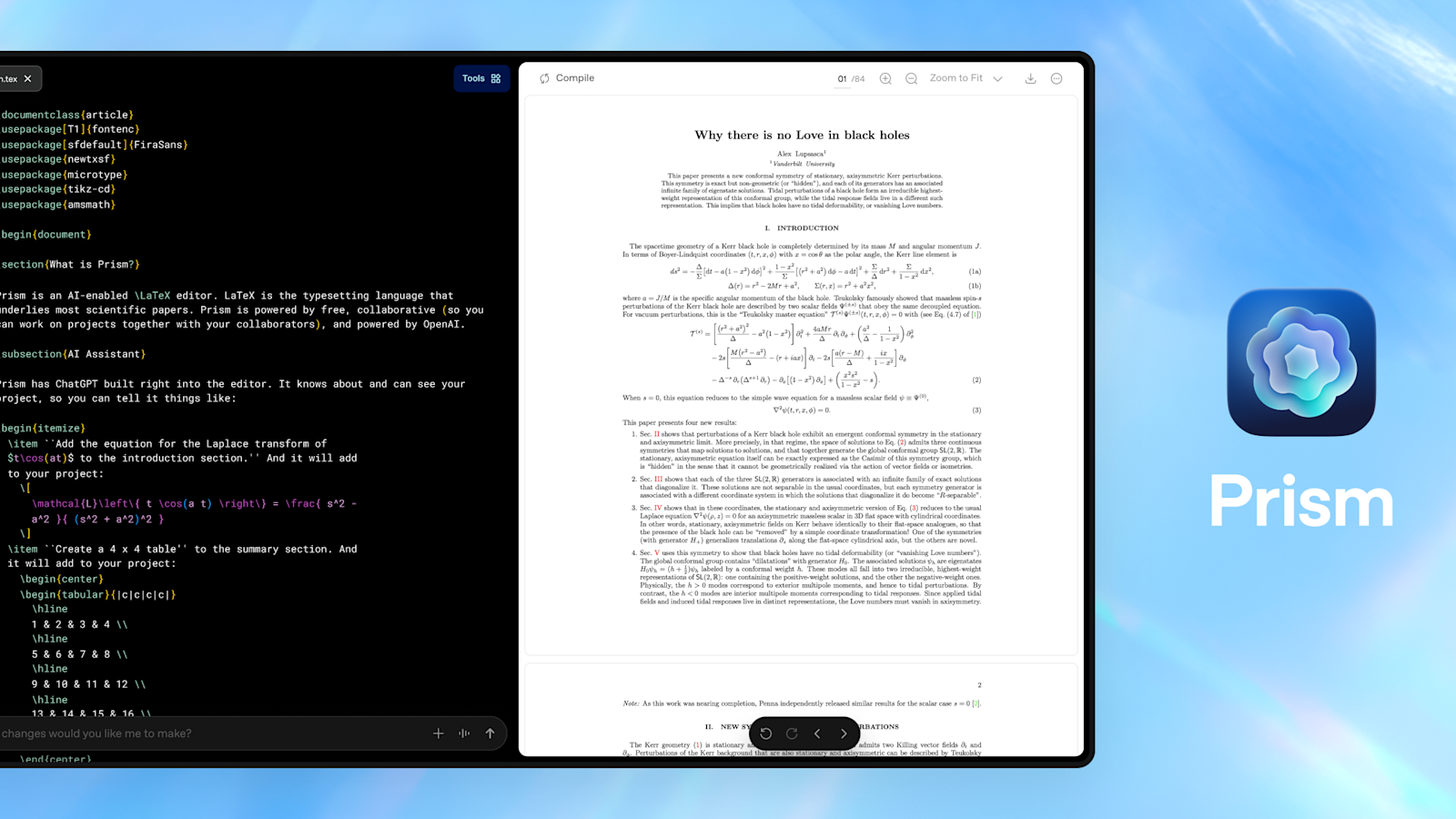
The scientific research landscape is poised for a transformative shift with OpenAI's introduction of Prism, an AI-native workspace designed to revolutionize how scientists write, collaborate, and advance discovery. Built on the foundation of GPT-5.2, OpenAI's most sophisticated model for mathematical and scientific reasoning, Prism represents a fundamental reimagining of the research workflow.The platform addresses a persistent challenge in modern science: while AI capabilities have advanced exponentially, the day-to-day tools researchers rely on have remained largely unchanged for decades. Scientists typically juggle multiple disconnected applications—LaTeX editors, PDF viewers, reference managers, and separate collaboration tools—creating friction that slows the pace of discovery.Prism consolidates these fragmented workflows into a unified, cloud-based environment where GPT-5.2 operates not as an external assistant, but as an integrated component with full access to paper structure, equations, references, and contextual information. This deep integration enables the AI to provide more relevant and sophisticated assistance throughout the research process.The democratization aspect of Prism is particularly noteworthy. Unlike many professional research tools that require expensive institutional licenses, Prism is freely available to anyone with a ChatGPT personal account, with unlimited projects and collaborators. This accessibility could significantly lower barriers to scientific participation, potentially expanding the global research community.Built upon Crixet, a cloud-based LaTeX platform that OpenAI acquired and evolved, Prism eliminates the technical overhead of local installations and version management that often hampers collaborative research. The platform's cloud-native architecture enables seamless real-time collaboration across institutions and geographies, addressing the inherently collaborative nature of modern scientific work.OpenAI's timing appears strategic, positioning 2026 as a potential inflection point for AI in science, comparable to how AI transformed software development in 2025. Early indicators support this trajectory—advanced reasoning systems are already accelerating mathematical research, enhancing immune-cell experiment analysis, and speeding molecular biology iterations.For organizations, Prism will soon integrate with ChatGPT Business, Enterprise, and Education plans, with enhanced AI features expected to roll out through paid tiers over time. This tiered approach suggests OpenAI's intention to scale from individual researchers to institutional adoption.The broader implications extend beyond workflow optimization. By reducing mechanical overhead and version conflicts, Prism could free researchers to focus more intensively on the intellectual substance of their work, potentially accelerating the pace of scientific breakthrough across disciplines.As the platform launches today at prism.openai.com, the scientific community will serve as the ultimate test of whether AI-native tools can indeed fulfill their promise of transforming research velocity and collaboration quality. Source: OpenAI