OpenAI Launches Prism: AI-Native Workspace Targets Scientific Research
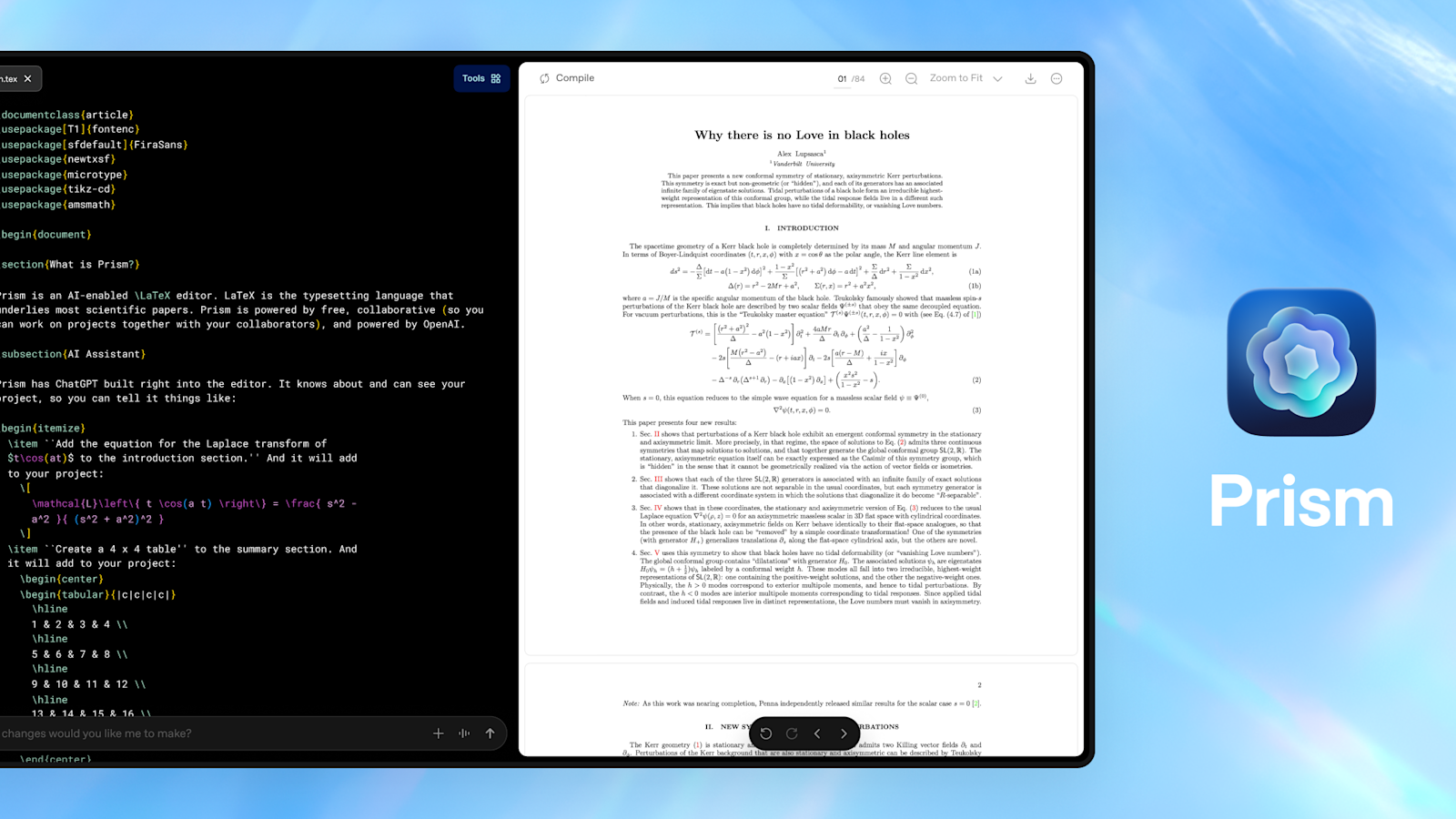
OpenAI has launched Prism, a groundbreaking AI-native workspace designed to revolutionize how scientists write, collaborate, and conduct research. The free platform, powered by GPT-5.2, represents a significant step toward addressing the fragmented nature of modern scientific workflows.The timing couldn't be more critical. While AI has rapidly advanced across multiple sectors, scientific research has remained tethered to tools that haven't fundamentally evolved in decades. Researchers typically juggle between editors, PDFs, LaTeX compilers, reference managers, and chat interfaces—a workflow that fragments focus and slows discovery.Prism consolidates these disparate elements into a unified, cloud-based environment. The platform integrates drafting, revision, collaboration, and publication preparation within a single LaTeX-native workspace. Unlike traditional AI tools that operate separately from the writing process, GPT-5.2 works directly within projects, accessing paper structure, equations, references, and contextual information.The platform builds on OpenAI's acquisition of Crixet, a cloud-based LaTeX platform that provided the foundation for this integrated approach. This strategic acquisition enabled OpenAI to combine mature collaborative writing capabilities with advanced AI reasoning, creating a seamless scientific workflow.Accessibility stands as a core principle of Prism's design. The platform offers unlimited projects and collaborators without seat limits or subscription barriers for ChatGPT users. This democratization of high-quality scientific tools could significantly expand research participation across institutions, disciplines, and career stages.The implications extend beyond convenience. Advanced reasoning systems like GPT-5 are already demonstrating impact across scientific domains—from accelerating mathematical frontiers to speeding experimental iteration in molecular biology. OpenAI positions Prism as an early step toward a 2026 inflection point where AI fundamentally transforms scientific discovery.For the global research community, Prism represents more than a productivity tool—it's a glimpse into a future where AI doesn't replace scientific thinking but amplifies it. As research teams worldwide grapple with increasingly complex challenges, from climate change to disease, tools that reduce friction while maintaining rigor could prove transformational.The platform is available immediately to ChatGPT personal account holders, with organizational plans rolling out soon. According to OpenAI's announcement, more advanced AI features will be introduced through paid ChatGPT plans over time.