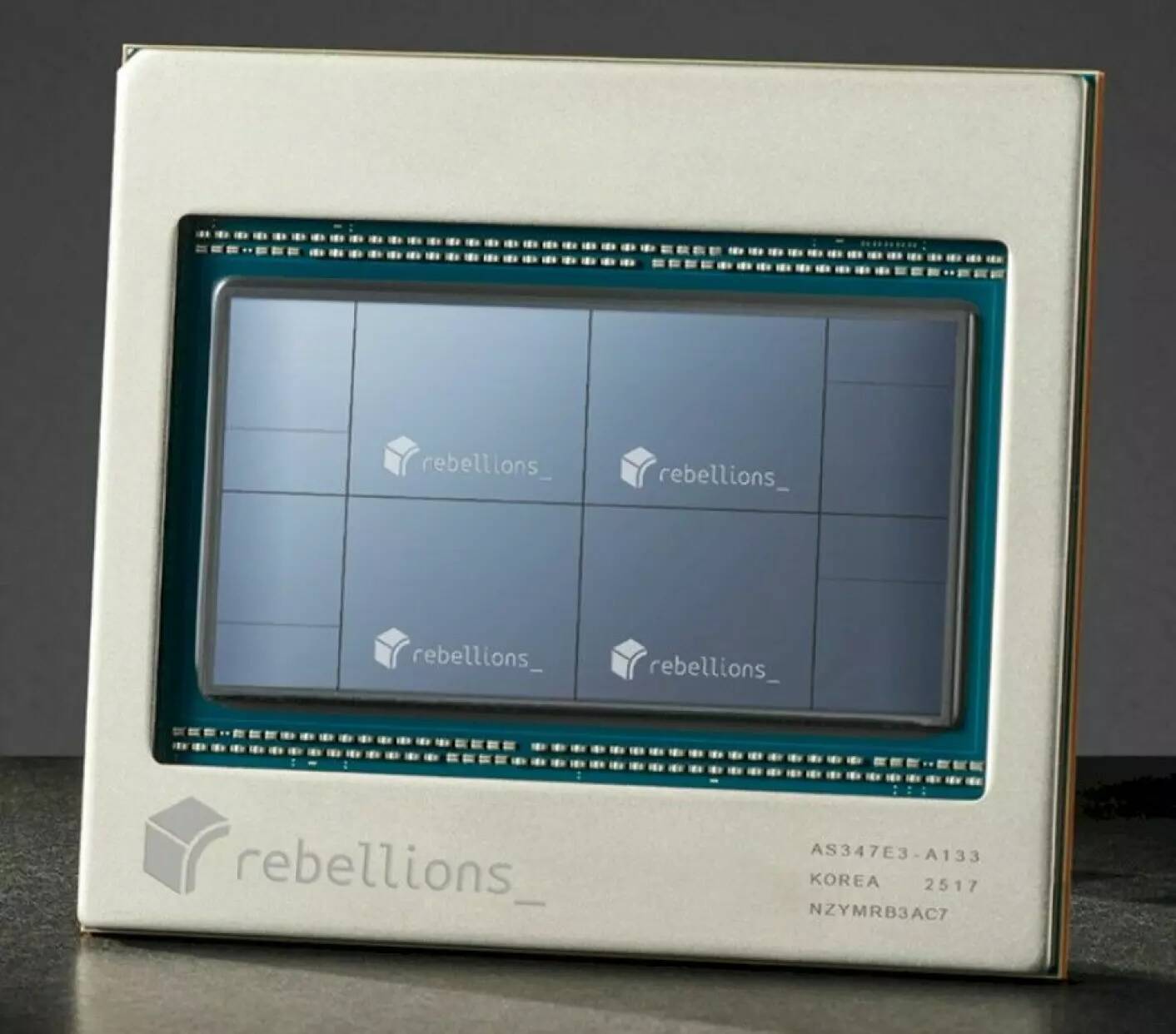
South Korean artificial intelligence chip startup Rebellions announced a significant $400 million funding round on Monday. This capital injection supports the company’s aggressive strategy to expand beyond its domestic market into Japan, Saudi Arabia, Taiwan, and the United States. The move comes as the industry seeks alternatives to dominant GPU vendors like Nvidia and AMD.
Mirae Asset Financial Group and the Korea National Growth Fund led the investment to bolster international operations. The startup intends to use these funds to support its westward expansion and develop more efficient AI accelerators. Reports suggest the company could file for an initial public offering as early as this year or early next year.
Central to this expansion is the Rebel100 accelerator, which utilizes a chiplet architecture manufactured by Samsung. Unlike monolithic competitors, this design employs four compute dies to potentially improve yields and reduce reliance on TSMC capacity. The processor delivers up to a petaFLOP of dense 16-bit floating point math with significant memory bandwidth.
Rebellions distinguishes its hardware by avoiding the need for liquid cooling systems required by some high-density racks. Their reference design places eight cards into a single air-cooled node within standard 19-inch chassis. This approach allows enterprises to deploy the technology in existing facilities without significant infrastructure overhaul.
System Scaling and Networking
The RebelRack configuration features four nodes connected via quad-400 Gbps networking for a total of 32 accelerators. For larger needs, the RebelPod system scales from eight to 128 nodes using 800 Gbps Ethernet. These systems aim to provide 64 petaFLOPS of FP8 compute within a single rack unit.
The platform runs on open source frameworks like vLLM, PyTorch, and Triton to ensure compatibility with developer workflows. Rebellions is a member of the PyTorch Foundation, which helps validate its software stack against industry standards. This openness contrasts with some proprietary solutions that limit developer flexibility and integration.
"We're in a very strong position to take those learnings, capabilities, and improvements we've done over the years and bring that out to other regions," Marshall Choy said.
Choy noted that the company plans to expand thinking from rack level to datacenter level operations soon. Networking fabric remains a major focus for future development to match current industry expectations. The firm acknowledges that compute and networking are only two pieces of the puzzle.
This funding positions Rebellions to test its supply chain advantages against global giants in a competitive landscape. Access to Samsung and SK Hynix for HBM memory provides a crucial edge in a tight global market. The successful integration of these components will determine if the alternative hardware gains traction.
Broader industry analysts watch this development closely as datacenter power constraints tighten worldwide. The ability to avoid liquid cooling could significantly lower adoption barriers for non-specialized enterprise clients. Future success depends on matching software ecosystem maturity alongside hardware performance metrics.