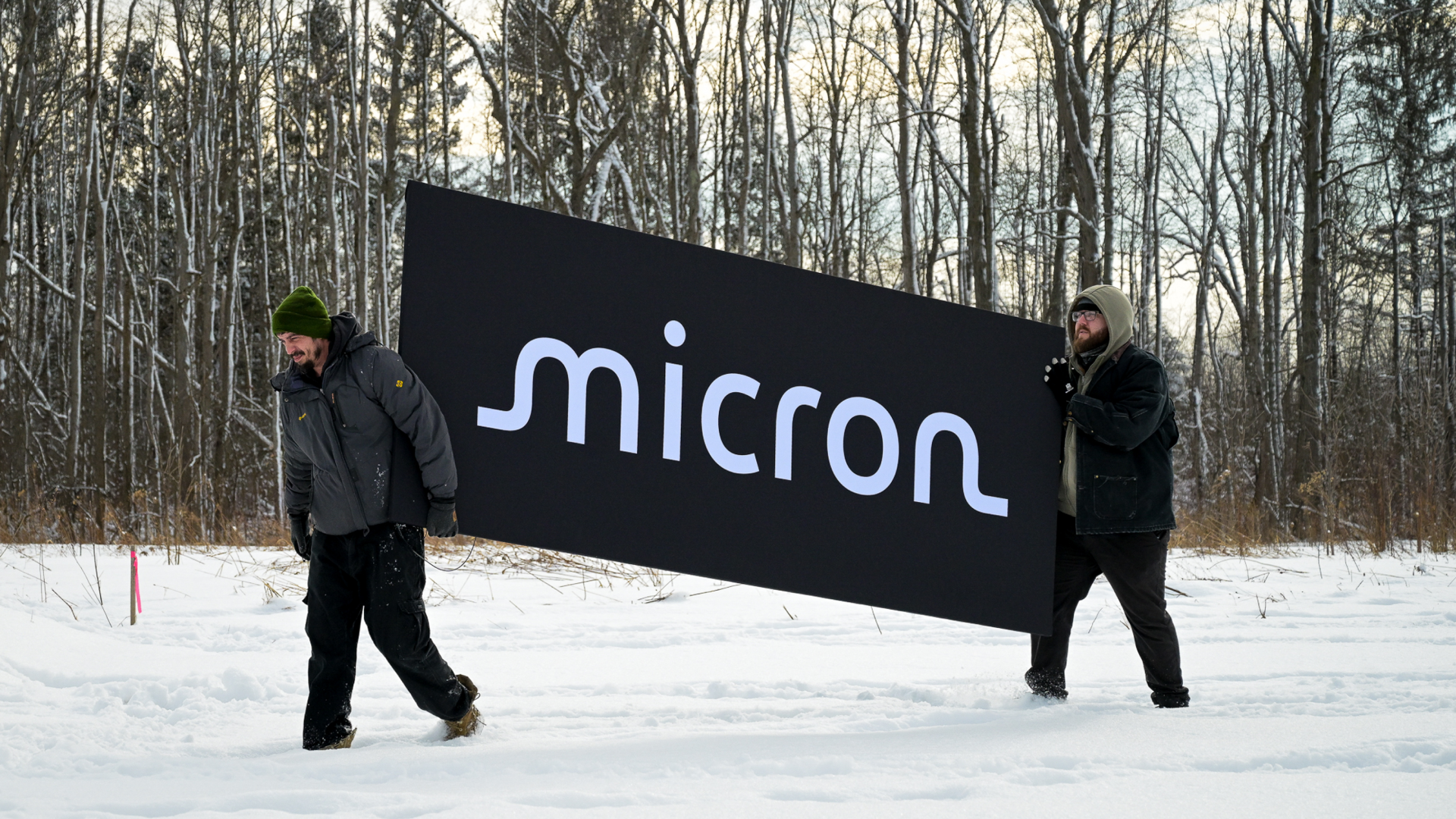
Micron Technology recently broke ground on a major fabrication project in central New York, signaling its commitment to capitalizing on the artificial intelligence boom. This expansion comes as the Boise-based semiconductor giant strives to navigate an increasingly unpredictable international trade landscape. The facility is expected to consist of four massive plants, each comparable in size to ten football fields.
According to a report from CNY Central, the new complex represents a significant capital investment intended to secure supply chains. This move mirrors actions taken by competitors like Samsung and Intel to localize production away from volatile regions. Micron maintains existing facilities in Idaho, Virginia, Singapore, Taiwan, China, and Japan.
From Dentist Basements to Memory Chips
The company traces its origins to 1978, when Dennis Wilson and Doug Pitman founded the business in a basement beneath a dentist's office in Idaho. Co-founders Joe and Ward Parkinson joined the venture, with Ward leaving the legal profession to helm the new DRAM company. Their decision to locate in Boise came after Pitman visited the city and purchased a home there immediately.
A critical factor in the company's survival was an early investment of one million dollars from J.R. Simplot, a wealthy potato and onion magnate. Simplot's capital allowed Micron to begin fabricating 256K DRAM chips by 1986, though the company still faced stiff competition from Japanese manufacturers. This financial lifeline proved essential when the firm reported a loss of 28.1 million dollars between August 1985 and June 1986.
"I almost died. There was my long pause. Then I said, 'Well, I guess we're going to Boise.'" Ward Parkinson told the Idaho Statesman in 1997.
Micron actively lobbied the U.S. government to impose tariffs on imported memory chips to protect domestic market share. An accord reached in September 1986 required Japanese manufacturers to stop selling chips below their cost of production. However, computer companies later argued that these trade agreements inadvertently drove the industry into a DRAM shortage by 1988.
Leadership Shifts and Future Risks
Relations between the Parkinson brothers and Simplot eventually became strained, leading to a leadership transition in 1994. Steve Appleton replaced Joe Parkinson as CEO after a personal clash reportedly involving insider information fears. Appleton, who was only 34 years old at the time, had joined Micron as production staff in 1983.
Today, Micron stands as one of the world's top 10 semiconductor companies, heavily involved in supplying memory for AI data centers. The recent New York project aims to weather tariffs and ensure capacity meets the surging demand for high-bandwidth memory. This strategic pivot underscores the long-term volatility inherent in memory manufacturing cycles.