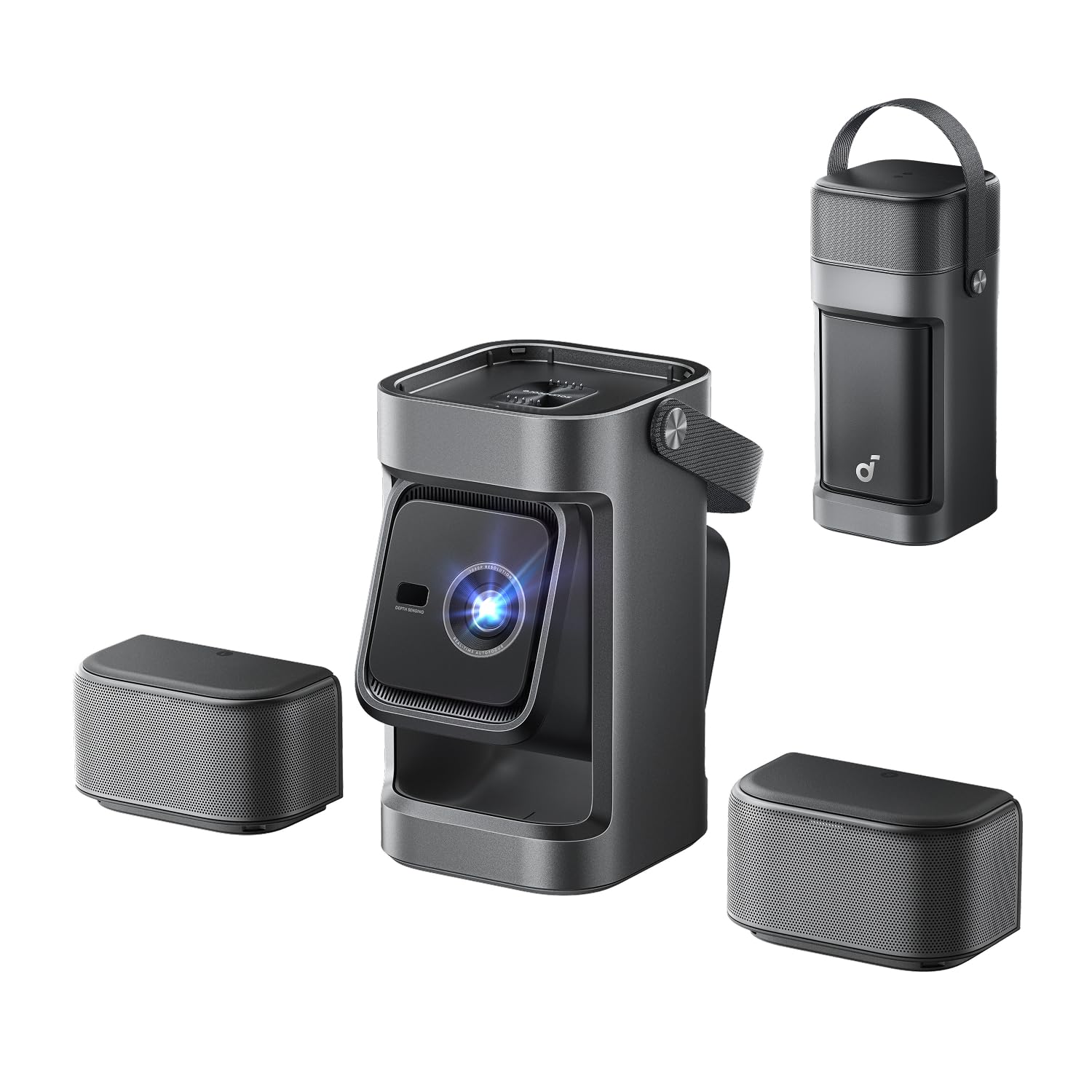
Anker has officially unveiled the Nebula P1, a $799 portable projector that prioritizes audio performance above all else. Unlike many competitors that focus solely on ultra-portability, the P1 offers a genuine stereo experience by utilizing a pair of detachable 10W speakers.
An Audio-First Portable Solution
According to reviews from The Verge, the sound quality of the Nebula P1 significantly outperforms the TCL PlayCube and Anker’s own Capsule series. Users can magnetically attach the speakers to either side of the projection screen to create a more immersive soundstage. When not in use with the projector, the speakers can function independently as Bluetooth speakers with up to 20 hours of battery life.
In terms of video performance, the P1 offers 1080p resolution with a brightness of 650 ANSI lumens. While it struggles in brightly lit environments, the image quality is more than sufficient for casual viewing in dim or indoor settings. The device runs on Google TV, supports major streaming apps like Netflix, and has a cold-boot time of approximately 50 seconds.
However, the product has a clear design flaw: the Nebula P1 relies entirely on an external power source and lacks an internal battery. This means that for outdoor use, users must carry a power bank capable of 100W USB-C output. Reviews note that when streaming Netflix at maximum brightness, the device drains power rapidly, severely limiting its flexibility in portable scenarios.
Furthermore, the Nebula P1’s smart features are underwhelming. Despite Anker’s claims regarding its "Intelligent Environment Adaptation (IEA 4.0)" technology, real-world testing shows that the auto-obstacle avoidance and screen alignment functions perform poorly. Users often have to resort to using Anker’s "VisionFit" mobile app to manually photograph the screen for calibration, which is a cumbersome process.
While the device boasts benefits like quiet operation (26dB) and an IP54 dust and water resistance rating, the lack of a built-in battery remains the biggest hurdle for users looking for a true "grab-and-go" experience. Compared to other products at this price point, competitors may offer a more cohesive approach to portability.