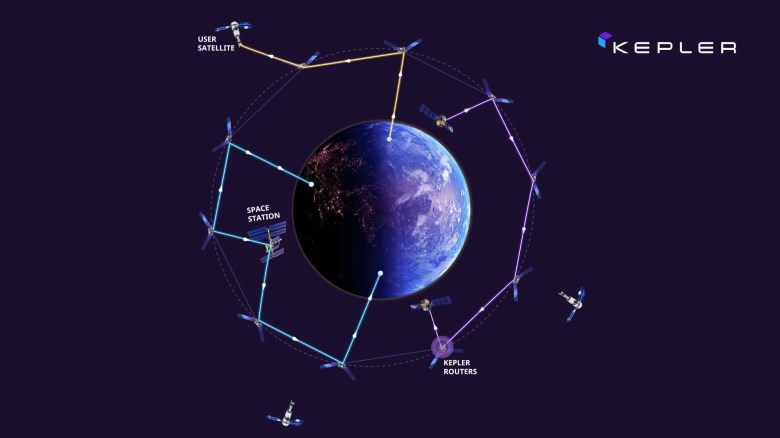
Canada’s Kepler Communications officially opened its orbital compute cluster for business this week, marking a shift in how satellite data is processed. The network, launched in January, currently utilizes 40 Nvidia Orin edge processors distributed across 10 operational satellites linked by laser communication.
Kepler confirmed Monday that Sophia Space has become the latest customer to join the platform. The startup plans to use the constellation to test software for its own proprietary orbital computers, which are designed to operate using passive cooling systems.
Testing the limits of space-based compute
For the upcoming test, Sophia Space will upload its operating system to a Kepler satellite. The goal is to configure the software across six GPUs spanning two separate spacecraft. This procedure, while standard in terrestrial data centers, marks a first for orbital operations.
"We don't see ourselves as a data center company, but as infrastructure for applications in space," Kepler CEO Mina Mitry told TechCrunch. He explained that the company aims to serve as a network layer for other satellites, as well as aircraft and drones operating in the sky below.
Industry experts anticipate that large-scale orbital data centers, such as those discussed by SpaceX or Blue Origin, will likely not emerge until the 2030s. Current efforts focus on processing data directly in orbit to enhance the performance of space-based sensors used by government agencies and private firms.
Sophia Space’s participation serves as a de-risking maneuver for its own hardware development. By validating its software on existing orbital infrastructure, the company hopes to prepare for its first dedicated satellite launch, currently slated for late 2027.
Managing heat remains a primary hurdle for orbital computing. Large-scale data centers typically require heavy, active-cooling systems that drive up launch costs. Sophia’s focus on passively-cooled hardware could provide a viable path to scaling compute power in space without the weight penalties associated with traditional thermal management solutions.