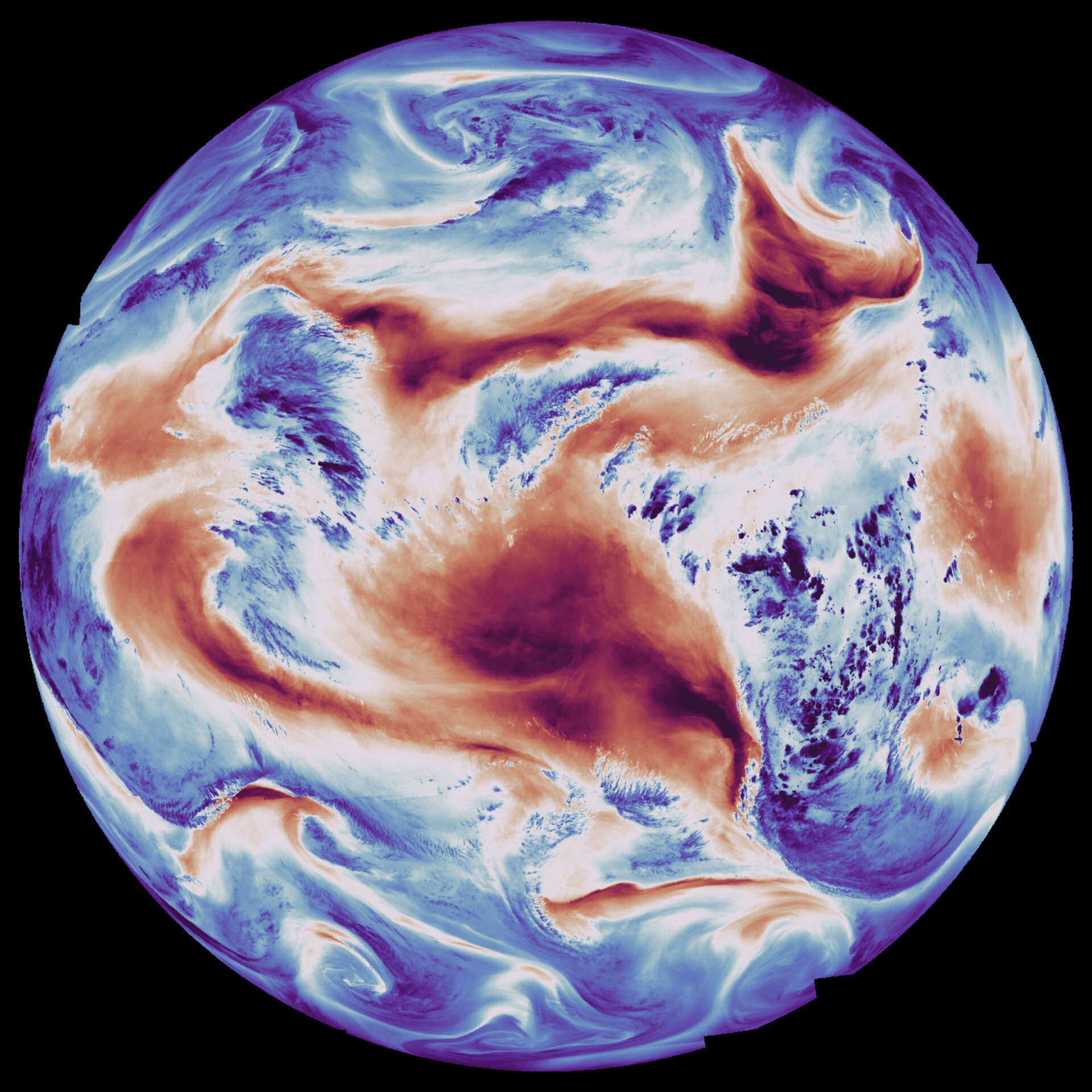
The next era of Earth observation has dawned. At the European Space Conference in Brussels, the European Space Agency (ESA) shared the inaugural imagery from the Meteosat Third Generation-Sounder (MTG-S), a mission poised to fundamentally reshape how we predict the weather.
Captured on November 15, 2025, from 36,000 km above the surface, the initial full-disc images reveal the planet with startling clarity. The Infrared Sounder instrument utilized long-wave infrared channels to map surface and cloud-top temperatures, painting continents like Africa and South America in warm reds, contrasting sharply with the cooler blues of cloud formations overhead.
Crucially, the MTG-S is delivering data that moves beyond simple surface views. A companion 'humidity' image, captured via the medium-wave infrared channel, delineates atmospheric moisture. Dark reds highlight arid zones over the Sahara and Middle East, while dense blue patches indicate high humidity, particularly over eastern Africa. This data fills critical gaps in our understanding of atmospheric dynamics.
ESA officials emphasized the mission’s impact on rapid forecasting. The geostationary platform ensures continuous coverage, supplying meteorologists with temperature and humidity data over Europe every 30 minutes. This complements the visual data from the MTG-Imager (MTG-I), creating a holistic, real-time picture of atmospheric evolution.
Perhaps the most transformative capability lies in the Sounder’s hyperspectral technology. Equipped with 1700 infrared channels, the instrument employs interferometric techniques to gather granular data on temperature, humidity, and trace gases. This allows for the construction of three-dimensional atmospheric profiles—a 'new type of data product' unavailable previously in Europe.
This vertical profiling capability is essential for 'nowcasting'—the precise prediction of rapidly developing, localized phenomena. As demonstrated by tracking the ash plume from Ethiopia's Hayli Gubbi volcano, the timely, evolving observations allow authorities to monitor fast-moving threats with unprecedented accuracy.
James Champion, ESA’s MTG Project Manager, noted that after 15 years of development, this mission will 'revolutionise weather forecasting and especially nowcasting.' The ability to profile the entire Earth disk every 30 minutes for the European sector represents a monumental technical achievement.
Developed in collaboration with industry partners and Eumetsat, the MTG mission, which also hosts the Copernicus Sentinel-4 payload, underscores Europe’s commitment to leading in Earth observation. As Simonetta Cheli, ESA’s Director of Earth Observation Programmes, concluded, this data will change how severe storms are forecast, offering tangible benefits to communities reliant on timely warnings.