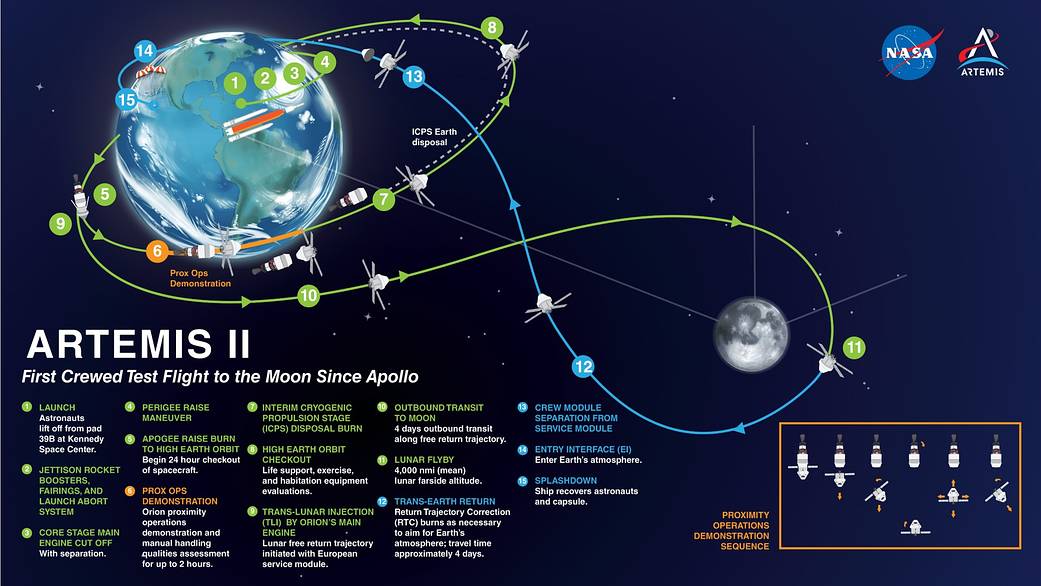
NASA’s Artemis II mission reached a historic milestone on Monday, April 6, as the four-person crew eclipsed a 56-year-old record for the greatest distance humans have ever ventured from Earth. According to The Verge, the Orion capsule sailed past the 248,655-mile mark previously set by Apollo 13, securing the crew’s place in the annals of space exploration.
Astronauts Reid Wiseman, Victor Glover, Christina Koch, and Jeremy Hansen commemorated the achievement with a crater-naming ceremony while in lunar orbit. The crew chose to name one of the craters "Integrity" in honor of their spacecraft. During the NASA livestream, Jeremy Hansen offered a poignant tribute to a personal loss: "A number of years ago, we started this journey and our close-knit astronaut family, and we lost a loved one. Her name was Carroll, the spouse of Reid, the mother of Katie and Ellie."
The mission, which launched from Kennedy Space Center on April 2, 2026, is designed to test the hardware and systems essential for establishing a permanent human presence on the Moon. As the crew continues their observations of the lunar surface, they also received a lighthearted message from flight controllers, believed to be the longest-distance person-to-person communication in history.
Advancing the Human Landing System
While the Artemis II flight continues to proceed smoothly, NASA is simultaneously refining the architecture for future lunar landings. Ars Technica reports that the agency is looking to fast-track the development of the Human Landing System (HLS), which will rely on vehicles provided by SpaceX and Blue Origin.
In a move to streamline operations, NASA has dropped the requirement for these landers to dock with the Lunar Gateway in a near-rectilinear halo orbit. Lori Glaze, who heads NASA’s deep space exploration program, confirmed that the agency is reviewing proposals to simplify mission requirements. "They’ve each brought in some good proposals. They’ve taken this very seriously. They’ve brought proposals to us about simplifying requirements so that they can really pull things in and accelerate," Glaze told Ars Technica.
While NASA has yet to release official details on the revised plans, reports indicate that Blue Origin is exploring options that bypass orbital refueling, while SpaceX is evaluating the possibility of docking Starship with Orion in low-Earth orbit. The current Artemis II mission is scheduled to conclude in 10 days, following a critical atmospheric reentry test this Friday.