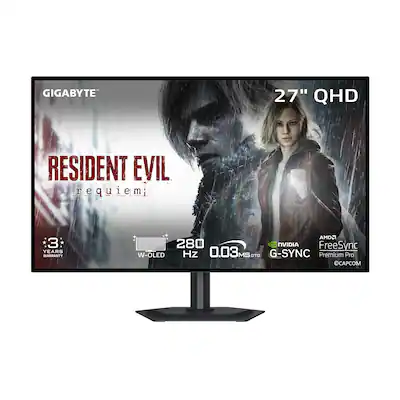
Gigabyte recently launched the MO27Q28GR, a 27-inch OLED gaming monitor aiming to capture the high-end enthusiast market. Despite the allure of its self-emissive display technology, reviewers point to significant hurdles that keep the product from securing a top-tier recommendation.
PC Gamer testing indicates that while the monitor delivers the deep blacks and rapid response times expected from OLED hardware, the overall package feels unrefined. The display suffers from a lack of competitive pricing, leaving it vulnerable to rivals that offer similar performance for less money. In fact, PC Gamer reported that Gigabyte has introduced a sibling model, the GO27Q24G, which uses an older LG WOLED panel but retails for $100 less while maintaining an identical chassis and build quality.
Performance versus value
Technical benchmarks highlight the monitor's strengths in motion clarity and contrast ratios. However, the editorial assessment notes that Gigabyte failed to pair these specs with a user experience that justifies the premium cost. PC Gamer noted that the MO27Q28GR uses a 4th Gen LG Primary RGB Tandem OLED panel, yet the visual experience is hindered by firmware and connectivity limitations that make it difficult to justify over cheaper alternatives.
"The Gigabyte MO27Q28GR is a decent screen, but it is currently fighting an uphill battle against better-priced alternatives," the PC Gamer review states. The publication highlights that other manufacturers are currently providing superior firmware support and more versatile connectivity options at lower price points.
Connectivity remains another sticking point for potential buyers. While the monitor covers the standard bases, it lacks the advanced port configurations found on newer, comparable displays. This limitation restricts the device's utility for users managing multiple high-bandwidth sources.
Build quality and interface design also received criticism during testing. The on-screen display menu is described as cumbersome, complicating the process of fine-tuning the monitor for specific gaming scenarios. For users seeking a "plug-and-play" experience, these software frustrations add friction to the daily operation of the screen.
Ultimately, the market for 27-inch OLED monitors is becoming increasingly crowded. Gigabyte’s latest entry finds itself squeezed between budget-friendly newcomers and established high-performance brands—including its own lower-cost models. Unless the company adjusts its pricing strategy or issues significant firmware improvements, the MO27Q28GR faces a difficult road to widespread adoption.