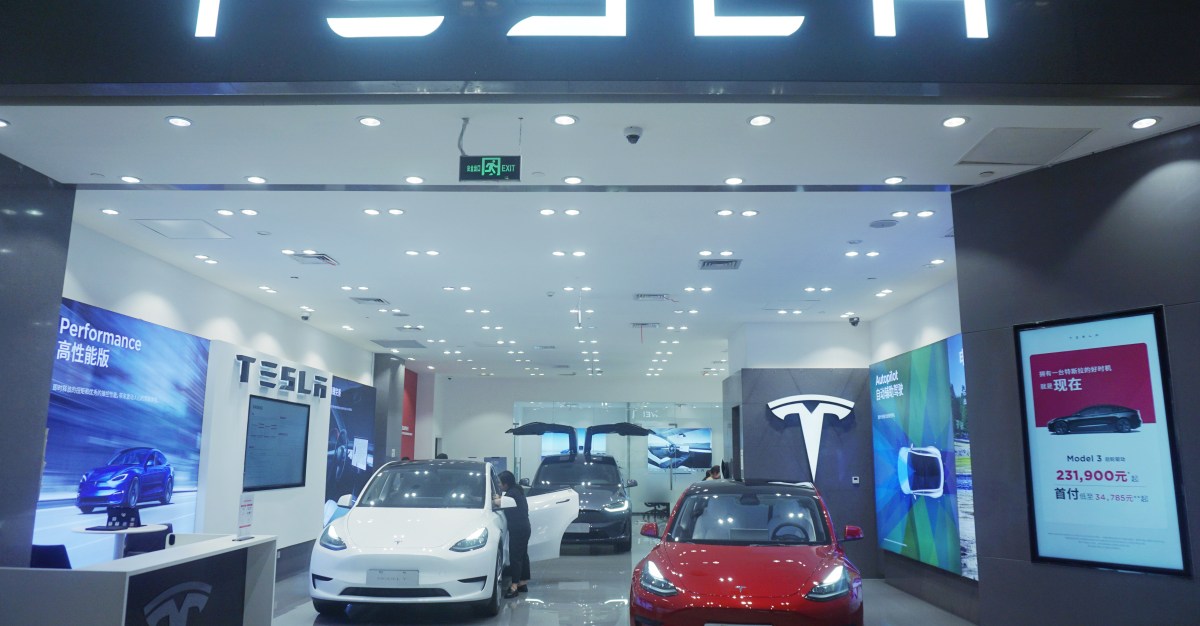
The narrative surrounding Tesla is undergoing a seismic shift. For the second straight fiscal year, the pioneering electric vehicle manufacturer has posted declines in both revenue and net income, signaling a tangible contraction in its core automotive business. For the fourth quarter ending December 2025, Tesla recorded $24.9 billion in revenue—a marginal 3% dip year-over-year—but saw net income plummet by a staggering 61% to $840 million. While Wall Street analysts had braced for a weaker showing, these figures underscore a growing disconnect between Tesla’s historical dominance and the current realities of a maturing, intensely competitive EV landscape.
This financial deceleration coincides with a critical loss of market leadership. China’s BYD officially surpassed Tesla as the world’s top EV seller in 2025, delivering 2.26 million units to Tesla’s reported 1.6 million. This nearly 8.5% year-over-year volume decrease for Tesla highlights the impact of an aging product lineup and the aggressive market penetration by domestic Chinese rivals. Globally, however, EV adoption continued its upward trajectory, growing by 20% in 2025—growth that Tesla is demonstrably failing to capture.
Analytically, several factors converge to explain this friction. Beyond the expected cooling of global EV growth due to subsidy expirations and policy shifts in Western markets, Tesla faces internal headwinds. The company’s brand equity appears strained, partly due to CEO Elon Musk’s increasingly polarizing public persona and political alignment, which analysts estimate has cost the company over a million potential sales from its historically liberal customer base.
Musk himself has acknowledged a period of 'rough quarters,' yet his strategic pivot remains centered on the future dominance of AI and robotics. The company's future valuation hinges on realizing the immense potential of FSD (Full Self-Driving), robotaxis, and Optimus humanoid robots. However, the progress in these transformative areas remains nascent; the promised mass deployment of robotaxis by the end of 2025 has materialized only in extremely limited, controlled pilot programs.
This strategic urgency is now financially codified. The recent shareholder approval of Musk’s massive, performance-based compensation package ties his future wealth—potentially making him the world's first trillionaire—to achieving unprecedented milestones, including the production of millions of robots and robotaxis, and generating trillions in shareholder value. This gambit places the weight of future valuation entirely on the success of these unproven AI ventures.
As Tesla navigates this automotive slowdown, its identity is clearly shifting from a pure-play automaker to a high-stakes AI technology incubator. The coming quarters will be crucial in determining whether the current dip is a temporary market correction or the beginning of a prolonged period where legacy automakers, leveraging established manufacturing scales and refreshed EV portfolios, finally erode the technological moat Tesla once enjoyed. The company's ability to deliver on its AI promises is no longer a secondary aspiration; it is the central thesis for its continued relevance in the modern tech ecosystem. (Source: Analysis based on Q4 2025 earnings reports and market context provided by The Verge.)